Get Graph Insights Faster
Our rocket science is in how we do graph processing—so you can launch your insight discovery to new frontiers.
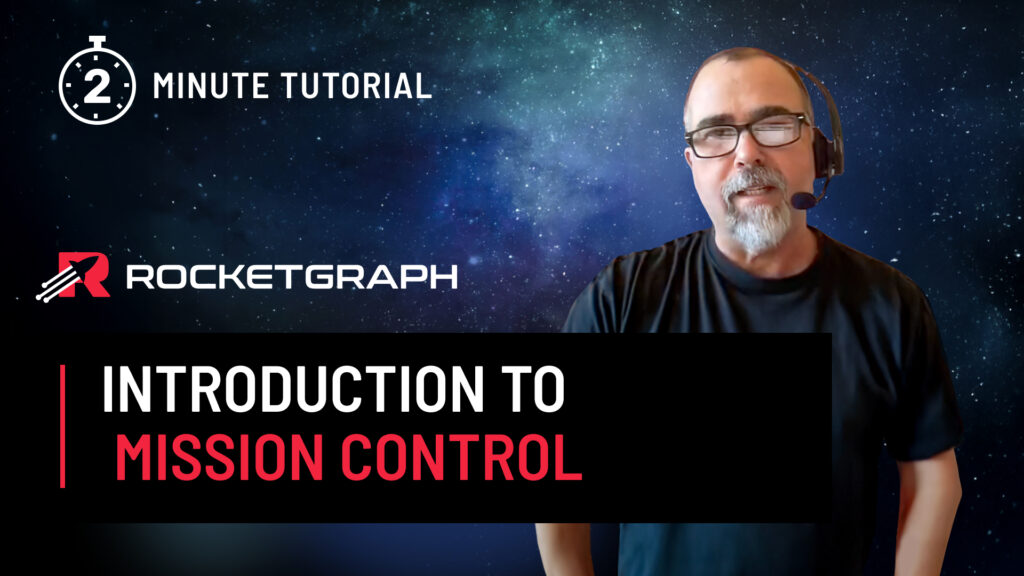
See Mission Control in action
HPC foundation, meet cutting edge AI
Rocketgraph delivers a unique combination of high-performance computing design, AI-first user experience, and seamless integrations that set it apart in the graph analytics market. Built on an HPC foundation based on U.S. Department of War requirements, Rocketgraph uncovers hard-to-find patterns and performs analyses that used to take days to run in mere minutes.
Why Use Rocketgraph?
Easy Deployment in the Cloud or on Prem

Whether deployed on-premise or through Aurora—Rocketgraph's fully-managed cloud offering—the platform eliminates traditional barriers to advanced graph analytics. Aurora represents a significant leap forward in accessibility, eliminating the need for on-premises hardware while integrating seamlessly with cloud-based data and applications. Users can get started in minutes, allowing data analysts to deliver insights without infrastructure delays. Rocketgraph handles all setup, maintenance, and compliance concerns, freeing teams to focus entirely on discovering insights rather than managing infrastructure.
Easy Deployment in the Cloud or on Prem
Whether deployed on-premise or through Aurora—Rocketgraph's fully-managed cloud offering—the platform eliminates traditional barriers to advanced graph analytics. Aurora represents a significant leap forward in accessibility, eliminating the need for on-premises hardware while integrating seamlessly with cloud-based data and applications. Users can get started in minutes, allowing data analysts to deliver insights without infrastructure delays. Rocketgraph handles all setup, maintenance, and compliance concerns, freeing teams to focus entirely on discovering insights rather than managing infrastructure.
Discover insights in 5 easy steps
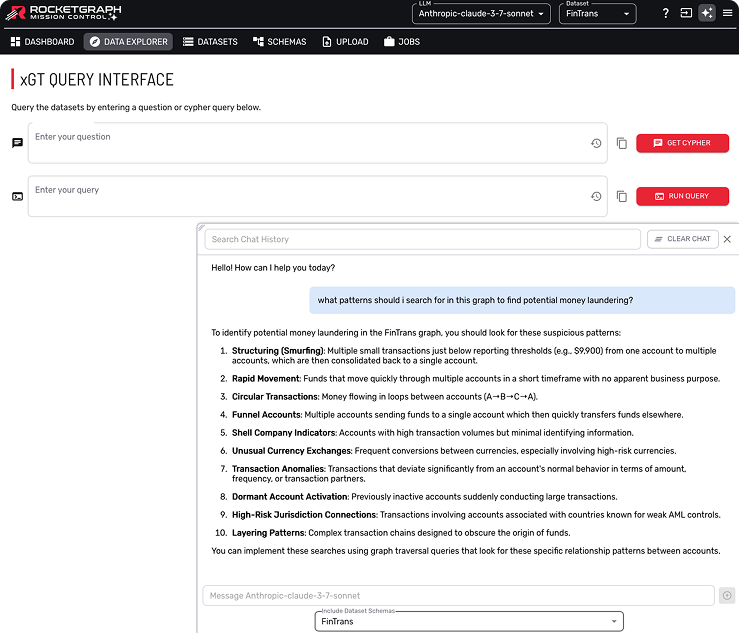
AI is your advisor and guide
No need to be a domain expert to get started. Simply pose a question in Rocketchat and let the LLM of your choice recommend strategies.
Automatic query generation
Not sure where to start? Ask a question and let AI recommend an approach.
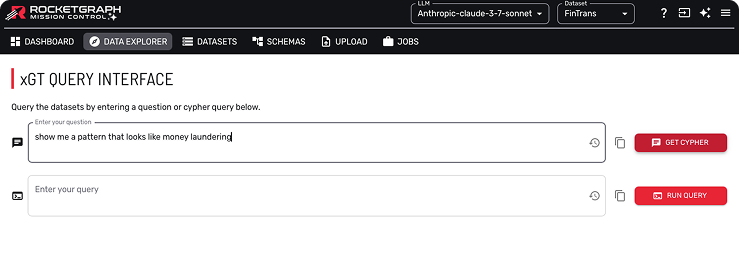
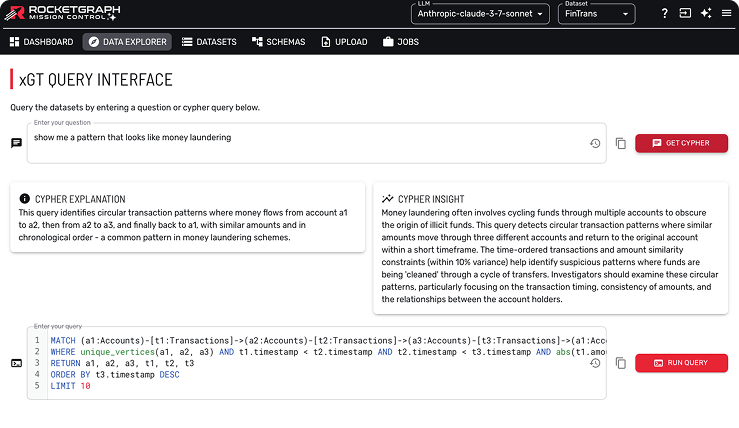
No Cypher? No problem.
Let AI provide you a recommended query to run as well as an English language explanation and recommended insights and next steps.
See it.
search it.
find it.
After reviewing the recommended code and making any desired changes, run it and instantly see the resulting graph.

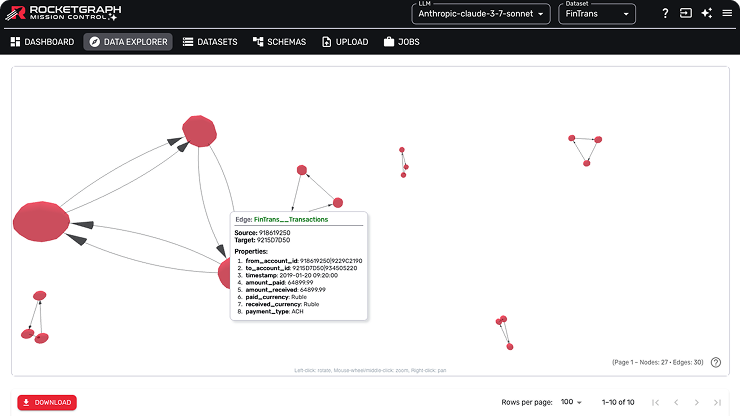
Translate insights into action
Rotate and zoom in on the graph result, mouseover to see edges and look for the desired pattern. Download the results with one click to take action.
Same Scalable Software - New No-Code Interface
What sets Rocketgraph apart is Mission Control — an AI-first user experience which makes using this powerful HPC engine easy and creating unique capabilities impossible with traditional graph tools.
Data scientists are no longer required—Mission Control automatically generates graph schemas from your data and translates natural language questions directly into optimized Cypher queries. This architectural approach unlocks three transformative capabilities:
- Analysts can see and search the entire graph without sampling or partitioning
- The graph is always current through direct connections to live data sources via connectors (databases, filesystems, S3, and snapshots)
- Users can simply ask a question in plain language and get an answer without writing code or needing to be experts in graph theory
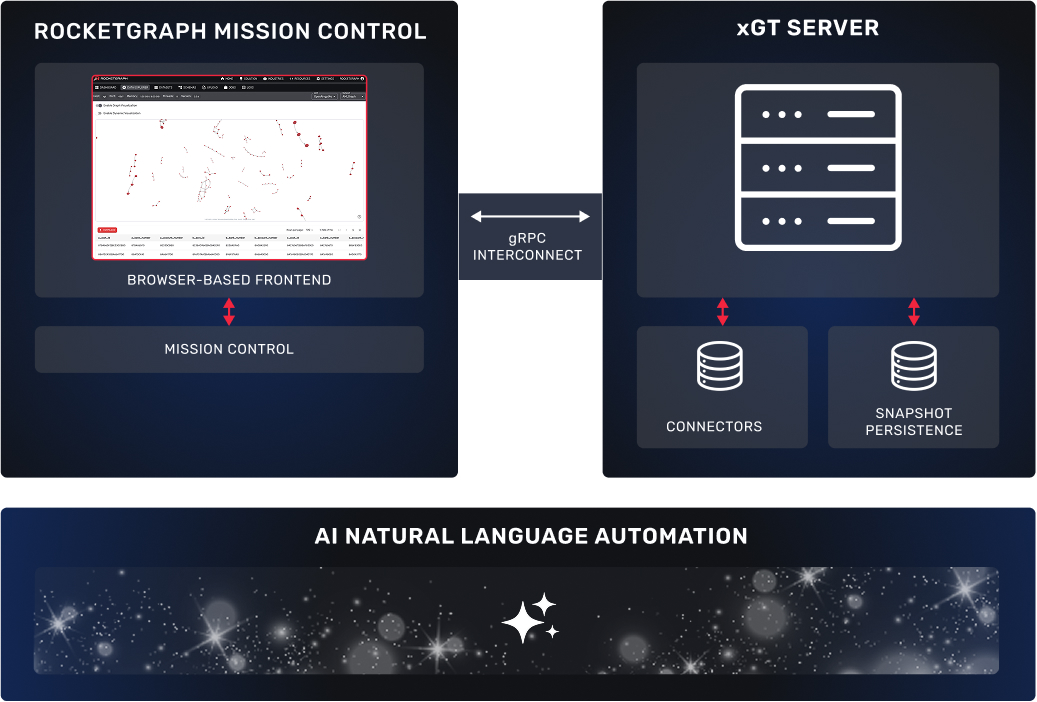

Architecture Principles
Rocketgraph's architecture delivers breakthrough performance through key AI and HPC design principles that maximize modern computing capabilities:
Built for Speed from Day 1
We are not a database. This was an intentional design from day one of our development. The platform operates entirely in-memory, eliminating the latency bottlenecks of traditional disk-based systems and enabling traversals across billions of nodes and edges at extreme speeds. It is the only way to maintain 1:1 scalability (performance : cores used).
Designed for World Size Problems
It’s high-efficiency engine is written and compiled to fully utilize modern chip features—SIMD instructions, multi-core parallelism, and optimized memory hierarchies—to extract maximum performance from commercially available hardware including x86, ARM, and IBM Power systems.
Analyst-ready
Analysts can search the entire graph without sharding, the graph is always current through direct connections to live data sources via connectors (databases, filesystems, S3, and snapshots), and users can simply ask a question and get an answer without being a rocket scientist.
FAQ
Your data is never sent to any LLM when you are using our agentic query and schema creation features. The LLM you chose to work with will only be sent the labels of your data. For example, if you were to look at customer data, we would only be sending the words “Name”, “Address”, & “Phone Number”, but not the Names, Addresses, or Phone Numbers themselves.
Rocketgraph has the ability to bookmark your favorite queries, as well as record your query and prompt history, so if you ever have a query you want to save, just bookmark to come back to it later.
No. The closest description to Rocketgraph is that it is an in-memory graph analytics platform designed for high-performance at all scales. This was an intentional choice during the initial development of Rocketgraph. Our team found that building a database-centric graph engine built in structural limitations to performance, particularly with whole graph search or unbounded search queries.
Because we are not a database, we can be an unobtrusive addition to any existing analytics environment. With specialized connectors to Oracle, Neo4j, Snowflake, and many more, Rocketgraph is built to act as an accelerator to your existing workflow.
Rocketgraph thrives on big data & query complexity. For starters, we handle a slew of use cases that every other graph software handles. Everything from Cybersecurity to Pharmaceutical research. Graph tools are built to be able to analyze relationships. We can analyse the same relationships but at a much larger scale than other solutions. Allowing you access to fast query responses on queries 100’s of times larger than other solutions are capable of.
Rocketgraph is frequently used on-premise by organizations who have either 1/ An existing on-premise footprint which would make cloud deployments difficult or 2/ Security requirements that limit the ability to run it in the cloud. Aurora is well suited to organizations who already have extensive data resources in the cloud or who want the ease of a fully managed cloud graph analytics platform.
Yes it can. In fact, some of our technology partners integrate with us because we have worked with them to create knowledge graphs which enhance their offerings.
Yes. In fact, we provide a dataset with Rocketgraph which can be used to try this out, and we have produced a series of two minute tutorial videos located here to show this process.
In theory, yes. But if you are already using Neo4j, Rocketgraph is well-suited for complimentary work. For example, Neo4j is quite good at bounded graph searches, whereas Rocketgraph excels at full graph scans or unbounded searches.
Yes. In fact, we have specific features to support path finding with Breadth First Search. We recently published a blog on this topic which can be found here.
We have closely integrated AI with the user-experience so analysts can get started with graph more quickly and produce more insights faster than they could previously.
The answer is more complex than a simple yes or no. But we have run a benchmark comparing the two which shows that Rocketgraph performs better than Neo4j on larger graphs and more complex queries. The benchmark can be found here.
First it’s important to set the context on how we evaluate the size of a graph. In our experience the best way to estimate the amount of work that needs to be done to search a graph is with the total number of edges. Nodes typically represent entities, like people, phones, computers, etc. whereas edges represent connections. So while we might have a graph with thousands of nodes, there could be tens of millions of connections. Rocketgraph has been used for graphs ranging in size from a few thousand edges to hundreds of billions.
FAQ
Your data is never sent to any LLM when you are using our agentic query and schema creation features. The LLM you chose to work with will only be sent the labels of your data. For example, if you were to look at customer data, we would only be sending the words “Name”, “Address”, & “Phone Number”, but not the Names, Addresses, or Phone Numbers themselves.
Rocketgraph has the ability to bookmark your favorite queries, as well as record your query and prompt history, so if you ever have a query you want to save, just bookmark to come back to it later.
No. The closest description to Rocketgraph is that it is an in-memory graph analytics platform designed for high-performance at all scales. This was an intentional choice during the initial development of Rocketgraph. Our team found that building a database-centric graph engine built in structural limitations to performance, particularly with whole graph search or unbounded search queries.
Because we are not a database, we can be an unobtrusive addition to any existing analytics environment. With specialized connectors to Oracle, Neo4j, Snowflake, and many more, Rocketgraph is built to act as an accelerator to your existing workflow.
Rocketgraph thrives on big data & query complexity. For starters, we handle a slew of use cases that every other graph software handles. Everything from Cybersecurity to Pharmaceutical research. Graph tools are built to be able to analyze relationships. We can analyse the same relationships but at a much larger scale than other solutions. Allowing you access to fast query responses on queries 100’s of times larger than other solutions are capable of.
Rocketgraph is frequently used on-premise by organizations who have either 1/ An existing on-premise footprint which would make cloud deployments difficult or 2/ Security requirements that limit the ability to run it in the cloud. Aurora is well suited to organizations who already have extensive data resources in the cloud or who want the ease of a fully managed cloud graph analytics platform.
Yes it can. In fact, some of our technology partners integrate with us because we have worked with them to create knowledge graphs which enhance their offerings.
Yes. In fact, we provide a dataset with Rocketgraph which can be used to try this out, and we have produced a series of two minute tutorial videos located here to show this process.
In theory, yes. But if you are already using Neo4j, Rocketgraph is well-suited for complimentary work. For example, Neo4j is quite good at bounded graph searches, whereas Rocketgraph excels at full graph scans or unbounded searches.
Yes. In fact, we have specific features to support path finding with Breadth First Search. We recently published a blog on this topic which can be found here.
We have closely integrated AI with the user-experience so analysts can get started with graph more quickly and produce more insights faster than they could previously.
The answer is more complex than a simple yes or no. But we have run a benchmark comparing the two which shows that Rocketgraph performs better than Neo4j on larger graphs and more complex queries. The benchmark can be found here.
First it’s important to set the context on how we evaluate the size of a graph. In our experience the best way to estimate the amount of work that needs to be done to search a graph is with the total number of edges. Nodes typically represent entities, like people, phones, computers, etc. whereas edges represent connections. So while we might have a graph with thousands of nodes, there could be tens of millions of connections. Rocketgraph has been used for graphs ranging in size from a few thousand edges to hundreds of billions.
Get Started with Rocketgraph Today
Want to find answers from your universe of data? Our Rocketgraph graph analytics platform gives you and your team the scalable launchpad to explore and discover the impossible.