Beat the Exploit Clock: From CVE Chaos to Proactive Remediation
Expose the Risk. Stop the Breach. Automate the Fix.
Introducing Attack surface management++
28.3% of new CVEs were
exploited within 24 hours
Traditional scanners leave
you drowning in alerts
graph tools cannot fix the
problems they find
We combine Rocketgraph's massive-scale graph analytics with Threatworx's proactive, AI-powered discovery and remediation. The result? A vulnerability management solution that doesn't just list problems—it prioritizes them by business impact and fixes them before attackers can strike.

Explore our use cases
The “Kill Chain” Breaker
The CISO Pain
We are drowning in "Critical" alerts (CVSS 9.0+). We cannot patch them all. We need to know which one vulnerability allows an attacker to pivot from a low-value test server to our "Crown Jewel" production database.
The Solution
- Rocketgraph ingests our entire asset map (network, identity, cloud) into its xGT in-memory engine, which can traverse billions of relationships.
- Threatworx provides the high-fidelity vulnerability data.
- The Win: We ask Mission Control: "Show me all internet-facing assets with active exploits that have a direct path to the Payments Database."
Rocketgraph visualizes the path, “the blast radius”; Threatworx provides the patch. - The Difference: Scale & Speed. Other graph-based tools choke when loading the full enterprise dataset (logs, assets, and netflow). Rocketgraph's xGT engine handles this in memory, delivering answers in seconds, not hours.
ROI / Savings
- Calculated ROI: $1.2M annually in Operational Efficiency.
- The Math: An average Level 2 analyst spends 4 hours researching asset context per critical alert. With 50 criticals/week, that's 10,000 hours/year. The Integrated Rocketgraph and Threatworx Solution can reduce research time to <5 minutes per alert, a 98% reduction in research time.
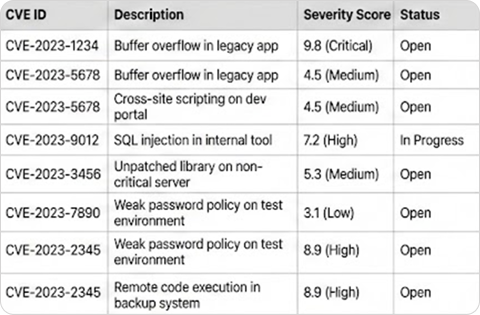
Before: Flat list of CVEs
(confusing scores)
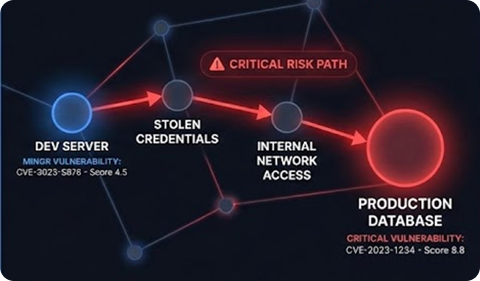
After: Rocketgraph kill
chain visualization
Zero-Day ”Flash Search”
The CISO Pain
When the next Log4j hits, the Board asks: "Are we exposed?" Our current answer is: "We are scanning, give us 48 hours." That is unacceptable.
The Solution
- Threatworx maintains a "Code-to-Cloud" inventory, including deep software dependencies (SBOMs).
- Rocketgraph indexes this entire web of dependencies.
- The Win: Type into Rocketgraph: "Where is log4j-core < 2.14.1 running right now?" Result: Instant global visibility across containers, code repos, and servers.
- The Difference: Unified Data Model. It connects the code (Threatworx finding) to the deployed Asset (Rocketgraph map). We see the risk before it's even compiled into production.
ROI / Savings
- Calculated ROI: $450k per Major Incident.
- The Math: During Log4j, we spent ~3,000 engineer hours on manual discovery and patching. Automated discovery cuts this by 90%.
No more Zero-day panic...
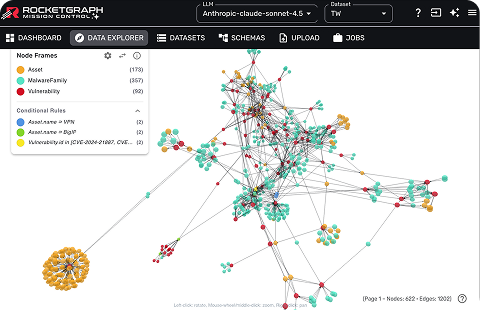
Global visibility within
seconds, not days
Automated Remediation of “Toxic Combinations”
The CISO Pain
Finding the threat is easy. Fixing it is hard. We have a 60-day backlog because Ops teams ignore security tickets that lack clear fix instructions.
The Solution
- Rocketgraph identifies a "Toxic Combination" (e.g., Asset A has a vuln + Asset A has admin privileges + Asset A is internet exposed).
- Threatworx automatically generates AI-validated remediation code or script.
- The Win: Security sends Ops a solution, not a problem. "Here is the script to update the library and close the port."
- The Difference: Native Remediation. Threatworx doesn't just trigger a ticket; it offers the actual code-fix/patch/remediation for any threat reported on your attack surface.
ROI / Savings
- Calculated ROI: 30% reduction in Mean Time to Remediate (MTTR).
- The Math: Reducing the exposure window from 45 days to 30 days significantly lowers the breach probability curve. Hard savings come from retiring standalone patching tools (~$150k/year).
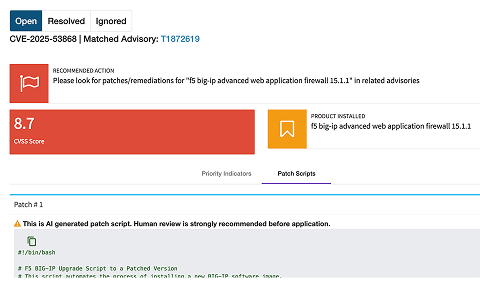
One-click fix for
“Ticket Toss” gridlock
False Positive Elimination (The “Attenu8” Filter)
The CISO Pain
Our scanners report 10,000 vulnerabilities. Threat intel says only 100 are actually being exploited. We waste massive resources chasing ghosts.
The Solution
- Threatworx Attenu8: Uses AI to curate threat intel from the dark web, flagging only active threats.
- Rocketgraph: Adds environmental context (e.g., "This asset is air-gapped").
- The Win: We auto-close 90% of "High" severity tickets that have no active exploit and no path to the internet.
- The Difference: Contextual Suppression. Standalone Intel tells you "CVE-2025-123 is bad." The Integrated Rocketgraph and ThreatworxSolution tells you "CVE-2025-123 is bad, BUT you are safe because of your firewall config."
ROI / Savings
- Calculated ROI: $500k in reclaimed Engineering Productivity.
- The Math: Developers spend 20% of their time dealing with security alerts. If 50% of those are false positives, we are wasting 10% of total engineering capacity. Reclaiming that creates massive value.
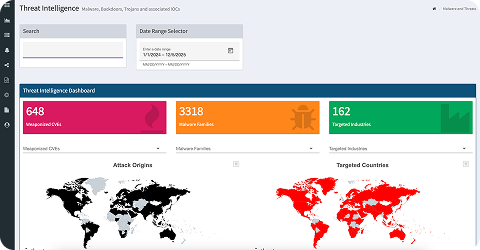
Analysts no longer drown in
endless “alert fatigue” …
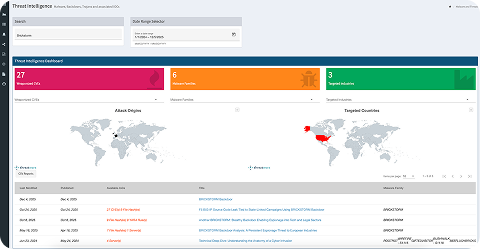
Because Threatworx+Rocketgaph filter out noise before reaching the analyst dashboard
FAQ
Standard VM tools act as list-generators. They find vulnerabilities but lack the context of how those vulnerabilities relate to your business operations. The Integrated Solution integrates Threatworx's comprehensive scanning (covering code, cloud, and endpoints) with Rocketgraph's high-performance graph analytics. We don't just tell you what is broken; we show you how it endangers your critical assets (blast radius) and provide the AI-generated scripts to fix it immediately.
No. While Rocketgraph is built on powerful graph technology, our Mission Control interface allows you to use natural language (GenAI) to ask questions about your security posture. You ask, "Where am I most exposed to the latest zero-day?" and the system translates that into the necessary graph queries, presenting you with a visual answer and a remediation path.
Yes. Unlike legacy tools that stop at "reporting," the Threatworx engine within the Integrated solution provides active remediation capabilities. It can generate AI-validated code fixes for application vulnerabilities and remediation scripts for infrastructure issues, allowing you to patch holes in minutes, not months.
We attack false positives from two angles. First, Threatworx's Attenu8 engine uses AI to curate threat data from the dark web, filtering out "theoretical" risks that aren't being exploited in the wild. Second, Rocketgraph applies environmental context. If a vulnerable asset has no path to a critical system or no internet exposure, its risk score is automatically downgraded.
Scale is our DNA. Rocketgraph's xGT core is designed for Department of Defense-level workloads and can traverse hundreds of billions of nodes and edges in memory. Whether you have 10,000 assets or 10 million, the Integrated Solution analyzes the relationships between them in near real-time without the performance degradation seen in traditional graph databases.
The Integrated Rocketgraph and Threatworx Solution is designed to complement your EDR (Endpoint Detection and Response) and SIEM (Security Information and Event Management), not necessarily replace them. While EDR protects endpoints and SIEM collects logs, the Integrated Solution provides the Proactive Attack Surface Management layer. We ingest data from your EDR and SIEM into our graph to model attack paths, helping you prevent breaches before your EDR has to block them.
We offer the best of both worlds. Threatworx capabilities include a "Universal Scanner" that is agentless, developer-friendly, and capable of zero-trust discovery across cloud and container environments. For deep forensic analysis or specific compliance needs, lightweight agents are also available.
The Integrated Rocketgraph and Threatworx Solution is designed for rapid value. With Rocketgraph's high-speed connectors and Threatworx's API-first architecture, we can immediately ingest data from your existing clouds (AWS, Azure, GCP), code repositories, and asset managers. Most customers can visualize their attack surface and see critical attack paths within the first 24 hours of deployment.
Rocketgraph operates as a high-performance analytics engine rather than a primary system of record. While all processing occurs in RAM for speed, data persistence is handled through two primary mechanisms:
- Snapshots & Checkpoints: You can configure Rocketgraph to periodically serialize the in-memory graph state to non-volatile storage (disk/SSD). In the event of a restart, the engine rehydrates the graph from the latest snapshot.
- Source-of-Record Sync: Most deployments treat the in-memory graph as "ephemeral but synchronized." Data is persisted in your data lake (S3, Parquet, CSV) or database (Neo4j, Postgres,MongoDB etc.). Rocketgraph ingests this data on startup or via streaming updates. Results and enriched graph data can be written back to these persistent stores for long-term retention.
You do not lose your source data, as that remains in your persistent storage (S3, SQL, etc.). You lose only the volatile in-memory state since the last checkpoint. For mission-critical uptime, we recommend a high-availability architecture where a secondary Rocketgraph instance mirrors the primary, ensuring that if one node fails, the other can immediately serve queries without needing a cold reload.
We have closely integrated AI with the user-experience so analysts can get started with graph more quickly and produce more insights faster than they could previously.
The answer is more complex than a simple yes or no. But we have run a benchmark comparing the two which shows that Rocketgraph performs better than Neo4j on larger graphs and more complex queries. The benchmark can be found here.
First it’s important to set the context on how we evaluate the size of a graph. In our experience the best way to estimate the amount of work that needs to be done to search a graph is with the total number of edges. Nodes typically represent entities, like people, phones, computers, etc. whereas edges represent connections. So while we might have a graph with thousands of nodes, there could be tens of millions of connections. Rocketgraph has been used for graphs ranging in size from a few thousand edges to hundreds of billions.
FAQ
Standard VM tools act as list-generators. They find vulnerabilities but lack the context of how those vulnerabilities relate to your business operations. The Integrated Solution integrates Threatworx's comprehensive scanning (covering code, cloud, and endpoints) with Rocketgraph's high-performance graph analytics. We don't just tell you what is broken; we show you how it endangers your critical assets (blast radius) and provide the AI-generated scripts to fix it immediately.
No. While Rocketgraph is built on powerful graph technology, our Mission Control interface allows you to use natural language (GenAI) to ask questions about your security posture. You ask, "Where am I most exposed to the latest zero-day?" and the system translates that into the necessary graph queries, presenting you with a visual answer and a remediation path.
Yes. Unlike legacy tools that stop at "reporting," the Threatworx engine within the Integrated solution provides active remediation capabilities. It can generate AI-validated code fixes for application vulnerabilities and remediation scripts for infrastructure issues, allowing you to patch holes in minutes, not months.
We attack false positives from two angles. First, Threatworx's Attenu8 engine uses AI to curate threat data from the dark web, filtering out "theoretical" risks that aren't being exploited in the wild. Second, Rocketgraph applies environmental context. If a vulnerable asset has no path to a critical system or no internet exposure, its risk score is automatically downgraded.
Scale is our DNA. Rocketgraph's xGT core is designed for Department of Defense-level workloads and can traverse hundreds of billions of nodes and edges in memory. Whether you have 10,000 assets or 10 million, the Integrated Solution analyzes the relationships between them in near real-time without the performance degradation seen in traditional graph databases.
The Integrated Rocketgraph and Threatworx Solution is designed to complement your EDR (Endpoint Detection and Response) and SIEM (Security Information and Event Management), not necessarily replace them. While EDR protects endpoints and SIEM collects logs, the Integrated Solution provides the Proactive Attack Surface Management layer. We ingest data from your EDR and SIEM into our graph to model attack paths, helping you prevent breaches before your EDR has to block them.
We offer the best of both worlds. Threatworx capabilities include a "Universal Scanner" that is agentless, developer-friendly, and capable of zero-trust discovery across cloud and container environments. For deep forensic analysis or specific compliance needs, lightweight agents are also available.
The Integrated Rocketgraph and Threatworx Solution is designed for rapid value. With Rocketgraph's high-speed connectors and Threatworx's API-first architecture, we can immediately ingest data from your existing clouds (AWS, Azure, GCP), code repositories, and asset managers. Most customers can visualize their attack surface and see critical attack paths within the first 24 hours of deployment.
Rocketgraph operates as a high-performance analytics engine rather than a primary system of record. While all processing occurs in RAM for speed, data persistence is handled through two primary mechanisms:
- Snapshots & Checkpoints: You can configure Rocketgraph to periodically serialize the in-memory graph state to non-volatile storage (disk/SSD). In the event of a restart, the engine rehydrates the graph from the latest snapshot.
- Source-of-Record Sync: Most deployments treat the in-memory graph as "ephemeral but synchronized." Data is persisted in your data lake (S3, Parquet, CSV) or database (Neo4j, Postgres,MongoDB etc.). Rocketgraph ingests this data on startup or via streaming updates. Results and enriched graph data can be written back to these persistent stores for long-term retention.
You do not lose your source data, as that remains in your persistent storage (S3, SQL, etc.). You lose only the volatile in-memory state since the last checkpoint. For mission-critical uptime, we recommend a high-availability architecture where a secondary Rocketgraph instance mirrors the primary, ensuring that if one node fails, the other can immediately serve queries without needing a cold reload.
We have closely integrated AI with the user-experience so analysts can get started with graph more quickly and produce more insights faster than they could previously.
The answer is more complex than a simple yes or no. But we have run a benchmark comparing the two which shows that Rocketgraph performs better than Neo4j on larger graphs and more complex queries. The benchmark can be found here.
First it’s important to set the context on how we evaluate the size of a graph. In our experience the best way to estimate the amount of work that needs to be done to search a graph is with the total number of edges. Nodes typically represent entities, like people, phones, computers, etc. whereas edges represent connections. So while we might have a graph with thousands of nodes, there could be tens of millions of connections. Rocketgraph has been used for graphs ranging in size from a few thousand edges to hundreds of billions.